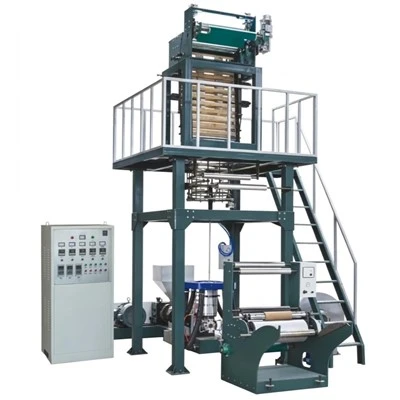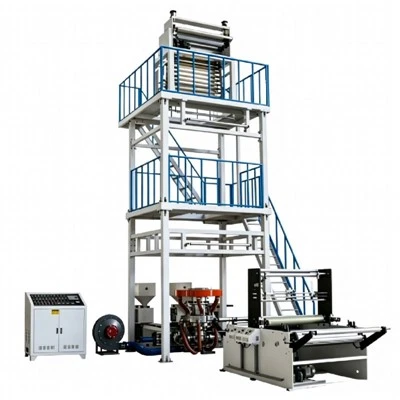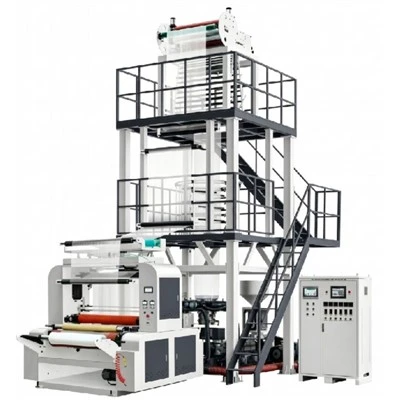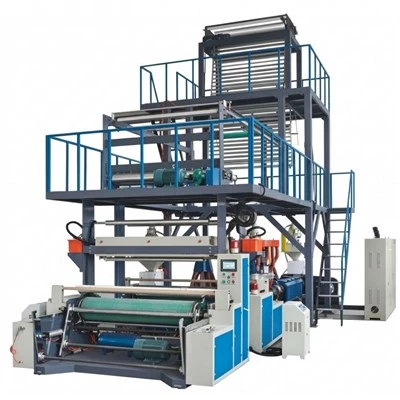

In a blown film extruder, compressed air is introduced at the die head to inflate the preform into a film tube. Adjusting the amount of compressed air introduced controls the degree of expansion of the film tube. The degree of preform expansion is usually expressed as the blow-up ratio α, which is the ratio of the diameter D2 of the inflated film tube to the diameter D1 of the extruder's annular die, i.e.: 1/2DD = α (6-1). The magnitude of the blow-up ratio indicates the change in the diameter of the extruded preform and also reflects the magnitude of the lateral stretching force on macromolecules in a viscous flow state. Commonly used blow-up ratios are between 2 and 6.
Film blowing is a continuous forming process. During the inflated and cooled film tube's ascent and winding, the degree of stretching is usually expressed by the draw ratio β. The draw ratio is the ratio of the film tube's speed v2 as it passes the clamping rollers to the speed v1 at which the die extrudes the preform, i.e.: 1/2vv = β (6-2). Thus, due to the simultaneous action of blowing and draw, the extruded preform is oriented in both the longitudinal and transverse directions, giving the blown film a certain mechanical strength. Therefore, to obtain a film with equal strength in both the longitudinal and transverse directions, its inflated ratio and draw ratio should ideally be equal. However, in actual production, the same annular gap die is often used, and the film thickness is controlled by adjusting different traction speeds. Therefore, the longitudinal and transverse strengths of the blown film are not the same; generally, the longitudinal strength is greater than the transverse strength.