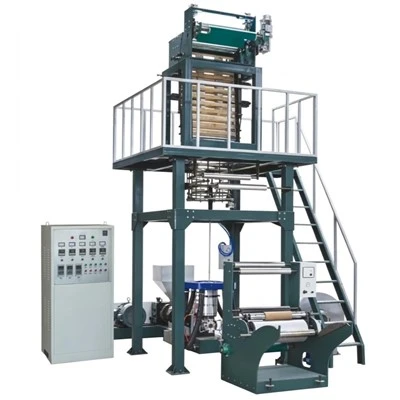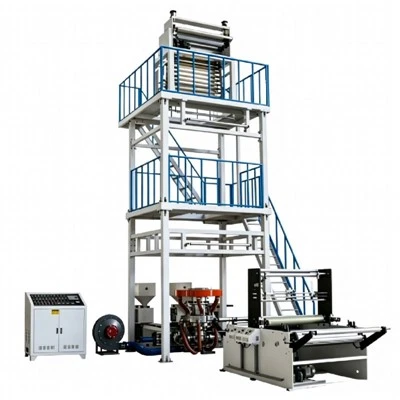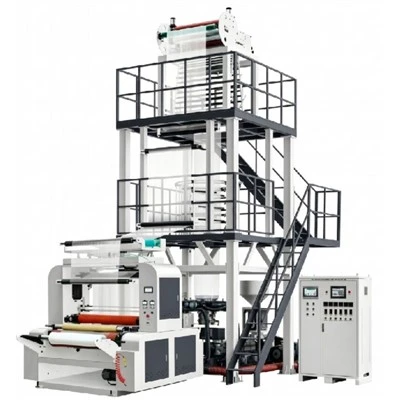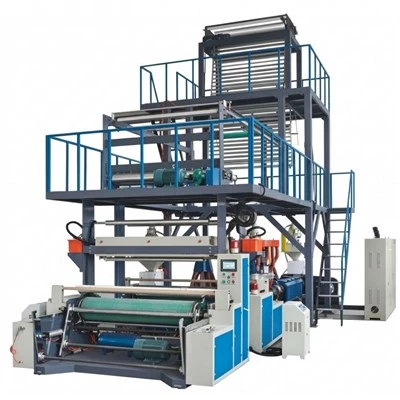

The extruder screw of a blown film extrusion machine is divided into three sections: the feeding section, the melting section, and the homogenization section.
At the end of the feeding section, before entering the melting section, according to melting theory, its temperature should be the viscous flow temperature. The viscous flow temperatures of various blown film resins are as follows: PP: 164-175℃, PE: 105-135℃, PA: 195-210℃.
1. Feeding Section Temperature Requirements At the inlet of the feeding section, a lower temperature is desirable to prevent the resin from clogging the feed port. Additionally, as the resin is continuously compressed in the feeding section, air should be expelled from the feed port. Depending on the equipment structure, although the feed port is not electrically heated, heat is transferred through the barrel, and the feed port temperature is approximately 50-90 degrees Celsius. Thus, the temperature of the feeding section is determined. With an inlet temperature of 50-90 degrees Celsius and an end temperature equal to the melting point or viscous flow temperature, a linear temperature increase can be adopted in this section.
2. Melting Section Temperature Requirements: At the beginning of the melting section, the temperature must reach the viscous flow temperature to melt. For crystalline resins, the viscous flow temperature equals the melting point. As compression and the molten layer increase, the temperature needs to rise continuously to ensure that polymers with varying chain lengths and different thermal energies melt sequentially. Therefore, once the temperature at the end of the melting section is established, the temperature rise in other parts of that section can be considered linear.
3. Homogenization Section Temperature Requirements: The homogenization section mainly involves remelting and homogenization, and quantitative, constant-pressure, and constant-temperature output of the melt. The temperature in this section can remain constant, or the temperature at the end of the melting section can rise slightly (around 2-5 degrees Celsius).
For blown films, the temperature at the die exit section should be lower, but not lower than the viscous flow temperature, to facilitate film lifting and normal blowing. The melt should have a certain viscosity when exiting the die to prevent film breakage or collapse. Generally, it is about 10-30 degrees Celsius lower than the end of the homogenization section. The temperature drop from the homogenization section to the die exit can also be considered a uniform temperature decrease.
Key Points for Extrusion Temperature Control:
1. Different resins require different extrusion film processing temperatures.
2. For the same resin, different grades and melt flow indices require different extrusion temperatures. Higher indices result in better flowability and require lower temperatures.
3. For the same resin, extrusion temperatures vary depending on film thickness. Thicker films can be processed at slightly higher temperatures.
4. A slightly higher die temperature can also help reduce viscosity and improve productivity.