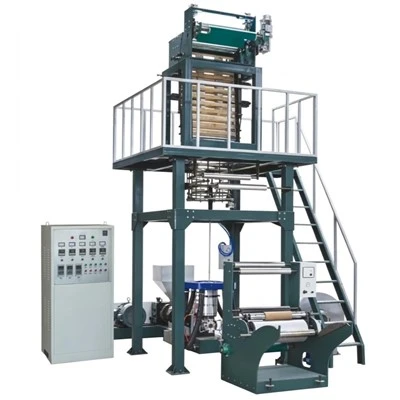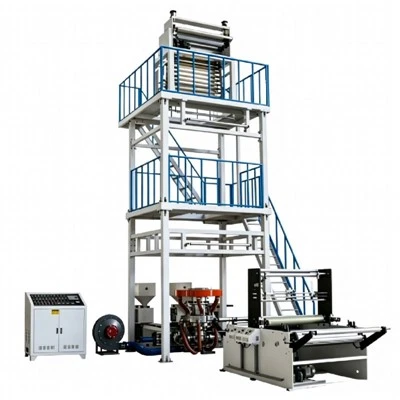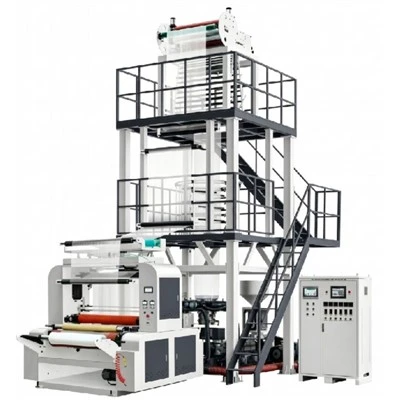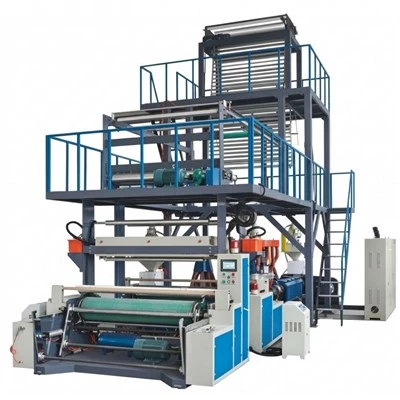

Underwater granulators are similar to airflow granulators and water spray granulators. The equipment mainly includes: plastic granulators, single and twin-screw plastic extruders, plastic blown film machines, bag making machines, printing machines, coating machines, tape machines, tape slitting machines, and strapping machines. Modified formulations primarily focus on alloy materials, especially PET, PC, ABS, and (PP, PA) materials whose applications are rapidly expanding. Plastic formulations developed include those for cling film, biodegradable films, and PET thickening and toughening. The difference lies in the presence of a steady stream of water flowing over the die surface, directly contacting it. The pelletizing chamber is sized just large enough to allow the pelletizing blades to rotate freely over the die surface without restricting the water temperature. Molten polymer is extruded from the die, the rotating blades cut the pellets, and the pellets are carried out of the pelletizing chamber by temperature-controlled water into a centrifugal dryer. In the dryer, the water is drained back into the storage tank, cooled, and recycled; the pellets are dried by the centrifugal dryer.
The strip production line is inexpensive, easy to operate, and convenient to clean. This has advantages for colorant blending because changing between two batches of different colorants requires thorough equipment cleaning. However, a disadvantage of the pelletizing method is that the cooling section requires space, the length of which is determined by the temperature requirements of the polymer.
Most polymers must be compounded and then pelletized before being made into a marketable raw material. The power required by the pelletizer is directly proportional to the extrusion rate and exponentially related to the screen size. There are many different pelletizer designs, but all pelletizers can be divided into two main categories: cold-cut pelletizing systems and die-cut hot-cut pelletizing systems. The main difference lies in the timing of the pelletizing process. In a cold-cut pelletizing system, pellets are cut from the solidified polymer at the end of the process; while in a die-cut hot-cut pelletizing system, pellets are cut as the molten polymer emerges from the die, and the pellets are cooled downstream. Both pelletizing systems have their advantages and disadvantages.
Cold-cut pelletizing system: A cold-cut pelletizing system includes a die, a cooling zone (air-cooled or water-cooled), a drying zone (if water-cooled), and a pelletizing chamber. There are two main types of cold-cut pelletizing systems: flake pelletizers and strip pelletizers.
Molten polymer is extruded from a hot die and cut into pellets by rotating blades that rotate on the die surface. A key feature of this pelletizing system is its specially designed water-jet pelletizing chamber. Water flows in a spiral around the die until it exits the pelletizing chamber. After being cut, the pellets are thrown into the water stream for initial quenching. The pellet slurry is then discharged into a pellet slurry tank for further cooling and then sent to a centrifugal dryer to remove moisture.
Strip pelletizers have a history of use almost as long as flake pelletizers. They consist of a die, a cooling section (water bath or blower), a drying section (if water-cooled), and pelletizing blades. Molten polymer is extruded through a horizontally mounted die using an extruder or gear pump to form strips (modern dies are precision-machined and uniformly heated to produce strips of consistent quality). After exiting the die, the strips are cooled by a blower or air/vacuum system, or by a water bath. If water cooling is used, the strips need to pass through a drying section where moisture is blown away by forced ventilation before being sent to the pelletizing chamber. The strips are then precisely cut to the required length using the shearing action of a pair of fixed blades and a rotating blade.